FAQs
How did XAccess start?
|
In 1994 a Stanford engineering student named Ross Evans
experimented with new designs for load-carrying bicycles.
The existing designs either had three wheels, put the weight
up front, or towed it behind in trailers. In short, they
carried weight but no longer rode like bikes. Through a
grant from the Stanford Center for Latin American Studies,
and the H. Michael Stevens Public Service Fellowship from
Stanford's Haas Center for Public Service, Evans traveled
to Nicaragua and started a bike fabrication shop teaching
Nicaraguan war veterans to repair and build cargo bikes.
While working at the shop in Nicaragua Evans invented a
two-wheeled bicycle conversion that could carry hundreds
of pounds in its rear racks and still ride like a bike.
Better yet, this invention could be produced at low cost
and attach to any existing mountain bike, extending its
wheelbase and turning it into a load-carrying bicycle.
In 1998, a Stanford friend named Kipchoge Spencer convinced
Evans that in order to fund world-class research and development
for his invention, he needed to start a company. Together,
Evans and Spencer founded Xtracycle LLC. Since then the
invention has shed pounds and taken on a sleek curvy look,
while its strength and utility have increased. The company
has appeared in Outside Magazine, Men's Journal, National
Public Radio, Adventure Cyclist, and at events such as the
Oregon State Fair, InterBike, the National Outdoor Retailers'
conference. Xtracycle also took second place in the 2000
Social Ventures Competition of the Haas School of Business.
Nearly a thousand people from around the world have purchased
Xtracycles, and reviews are positive! (For more information
about Xtracycle LLC, visit www.xtracycle.com .)
One early Xtracycle 'product tester' was Adam French, a
close friend of the founders and a fellow outdoors expert
with experience starting a non-profit in Africa. He helped
realize the dream of bringing freight cycling technology
to those who could least afford it by starting a new nonprofit
while Evans and Spencer continue to lead Xtracycle LLC.
The Foundation allows Xtracycle's superb technology and
design innovations to achieve their potential in places
American bicycle companies typically ignore.
|
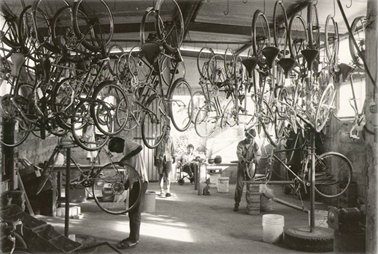
The roots of XAccess. The FABICAR bicycle workshop in Nicaragua,
started by XAccess founder Ross Evans in 1995 on a research
grant from Stanford University.
|
[ top ]
Why is XAccess needed? (An XAccess story.)
|
Ten years ago in the small west Kenyan town of Eldoret,
100 miles North of Kisumu, a farmer feeds his family of
three off his land. Six years later, his wife has complications
from the pregnancy of their fourth child. Forced to sell
half of his plot to afford medical care for his pregnant
wife, he knows he'll need to make money soon. His wife sees
an advertisement in a newspaper in the hospital for a human-powered
sunflower seed press that makes a valuable cooking oil.
After she has the child, they decide to spend the rest of
the money from the sale of the land on the press. A year
later, their hard work is beginning to pay off. They get
seed deliveries from three local farmers, and sell the home-pressed
oil to friends and in a weekly market. But the many bike
trips required to deliver the oil physically exhaust the
couple. The bottles bounce out of the small bike rack and
break. They're making enough to get by, but they don't have
the energy to raise their children the way they want to.
As for improving their transportation, buying a car is out
of the question - even the large imported bicycle rickshaw
at the credit union downtown costs over three year's income.
The couple find no option but to continue.
Riding to make a delivery in town with a heavy box of home-made
cooking oil balanced on his rack, the farmer passes a man
loading up an unusually long bicycle with two 100 pound
sacks of corn. He stops to talk to the man and check out
the bike. The front of it looks like a normal bike, but
where the rear wheel goes, a bright blue add-on frame begins,
with two built-in steel side racks and a top rack housing
the rear wheel. The man tells the farmer where to buy the
frame. The next day the farmer rides the bus 100 miles to
Kisumu, and buys one. It costs one month's income, a challenge
to save, but much less than a rickshaw because it reuses
the all the existing parts of his current bicycle. With
a friend who knows about bikes, he installs the new frame.
|
The next day he easily loads up what used to take four
bike trips in the bike's side racks. With over 140 pounds
of oil, the bike doesn't have its usual zip, but the farmer
has no problems balancing the load or maneuvering through
the tight streets. On his second and last trip of the day,
returning home with empty bottles to refill for his customers,
he picks his two kids up from the school and the three ride
home with the empty bottles cheerfully clinking along. He
and his wife have three hours more each day they can devote
to their kids, and they can increase their deliveries 25%
over their previous bike. With this jump in business they
will be able to pay off the new frame in four to eight weeks
and apply the increased profits toward building a better
home for their family.
This is the story that drives us. Load-carrying
bicycles make a huge impact on the fight against poverty
in developing nations, on a family-by-family level, without
the environmental impact of cars and trucks.
Third World nations are shifting from subsistence to cash
economies. Along with this change comes the need for job
creation, new businesses, and transportation. But we can't
simply apply the transportation solution used by the West
in the past century - massive dependence on the automobile
- because its expense is astronomical in Third World terms,
and its environmental impact has contributed substantially
to Global Warming.
XAccess believes an affordable, environmentally friendly
solution exists, and we are committed to finding it. We
connect key groups in the transportation equation to solve
this problem, and bring to the table valuable bike expertise
and freight-bicycle designs. Without an organization or
force to bring end-users, manufacturers, engineers, and
designers together, the solution won't happen. Thus our
organization is needed, to lead the effort to produce human-powered
transportation solutions that can create business opportunities
and support people through rapid changes in developing economies.
|
[ top ]
What is the mission of XAccess?
The mission of XAccess is to make load-carrying bicycles available
to people who can least afford them yet need them most. With simple
and extremely useful bikes, we help disadvantaged people get jobs,
start entrepreneurial businesses, and transport themselves and
their families, using the greenest power source around - human
power.
Where cargo bikes are unheard of, expensive, awkward to use,
or hard to make, we will educate people, distribute affordable
products, improve designs, and enable local fabrication to make
this vision a reality.
[ top ]
What is the initial strategy for achieving this
mission?
To find great models for deploying load-carrying bicycles, we
will continue to learn by doing. Our first project, and a promising
example of the results XAccess can achieve, was a partnership
with Afribike in Johannesburg, South Africa. Together with the
ITDP we helped Afribike establish a small manufacturing center,
and developed a design specific to their needs. Additionally we
assisted them in working with a large scale manufacturing facility
to produce the ExtraBike, which Afribike then made available to
the public through its existing network.
Our current project energy now turns to Kenya, where people have
a huge reliance on bicycles, but few options for carrying heavy
loads. We have partnered with ApproTEC, a nonprofit organization
which has successfully deployed a handful of human-powered technologies
in Kenya, such as a water pump and a seed oil press. Together
with ApproTEC, we will test and improve the ExtraBike product,
research ways Kenyans can use utility bicycles to start and improve
businesses, and distribute the ExtraBike to Kenyans. We will also
take away manufacturing techniques and expertise: new jigs and
fixtures, and quality control processes.
With each project, XAccess makes human-powered, environmentally
friendly, affordable transportation available, and improves our
understanding of developing-world transportation needs and distribution
models, and our own designs. As we continue to identify effective
models for distributing load-carrying bikes, and build our expertise
in local manufacturing, we will replicate our successes in new
settings. To help us pick future projects and partners, we will
continue to build our substantial network of bike-related organizations
and stay educated through this network.
To aid XAccess with its mission, Xtracycle LLC has granted XAccess
free use of the ExtraBike IP, which is covered under a US patent.
[ top ]
How is XAccess connected to a community or network?
XAccess is a young but well-respected group joining a vibrant,
worldwide community of people tackling issues of transportation
technology and development. Consistent with our strategy of connecting
producers, designers, manufacturers, and users of freight cycling
technology, our network may be our strongest asset.
Our contacts fall into four categories: industry (bicycle, adventure
sports, and technology companies), development organizations,
academia, and bicycle advocacy organizations.
As the ITDP writes, "Human powered vehicle technology desperately
needs to be modernized, and this can only be done in close cooperation
with the industry." Foremost within our set of industry contacts
is Xtracycle LLC, which manufactures and designs world-class Sport
Utility Bicycles. This is a phenomenal resource for industry contacts,
because through Xtracycle LLC we are able to attend major bicycle
industry events such as Interbike in Las Vegas, and learn about
philanthropic opportunities within the bicycle and adventure sports
world (ex: Patagonia Environmental Grants Program). Other industry
contacts include Freeplay, which manufactures and distributes
hand-powered lights and radios, freeing the user from battery
dependence. Freeplay has great experience distributing and manufacturing
technology in Africa.
Our development contacts include the ITDP, which works with the
World Bank's transportation division, among other projects. Additionally,
Adam French attended Work 2001, a conference hosted at the University
of Witwattersrand in South Africa. The conference opened speaking
and partnership opportunities and led us to focus on job creation
as part of our core mission.
Within academia, XAccess has strong ties to Stanford through
founder Ross Evans. Adam French recently attended a conference
hosted at MIT by an organization called Think Cycle whose goal
is "Creating a Culture of Design Innovation for Challenges in
the Environment and Underserved Communities." French also has
contacts at the University of Nairobi, who will be involved in
our project work in Kenya.
Our bicycle advocacy contacts are especially strong. We have
personal contacts at three of the most successful bike donation
programs: Pedals for Progress in New Jersey, Bikes Not Bombs in
Massachusetts, and Re-Cycle in England. Physically our desk sits
in the Berkeley Center for Alternative Transportation (CAT), which,
in itself is a fantastic way to stay immersed in the cycling world.
The CAT also houses Pedal Express, a bicycle delivery service,
Berkeley Friendly Bike Coalition, a local bike policy group, the
Bay Area Sustainable Transportation Project, which teaches schoolchildren
about alternative transportation, and Fab CAT, a membership-based
workshop for producing and experimenting with new bike designs.
The Berkeley CAT connects us to its sister organization, the Eugene
CAT, an internationally respected center for load-carrying bike
design.
We have built our network by locating our headquarters in a hub
of bicycle activity, attending relevant conferences, visiting
organizations, maintaining personal contacts, and meeting new
ones through the internet. We are currently producing a web site
that will allow others to find and contact us.
[ top ]
Who are the people of XAccess?
Key Staff:
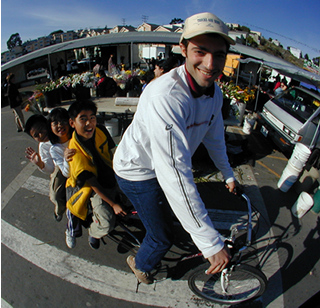 |
| Director Paul Freedman carrying three kids on the back of his Xtracycle at the Alemany Farmer's Market in San Francisco. |
Paul Freedman, Director: Paul brings 5 years experience in project management and communications in the high tech industry, and a passion for bicycle entrepreneurship. As a teenager growing up in Boston, he bicycled around New England and eventually rode across the USA in 1994. He went on to sell bikes in one of Boston's finest bike shops, Belmont Wheelworks. Observing the entrepreneurs from Boston's Merlin Metalworks and Seven Cycles sell their latest Titanium frames to Wheelworks' owner, he dreamed of one day returning to Wheelworks as an entrepreneur. Committed to the bicycle as key element of strong communities, Paul has bicycle commuted to every job he has ever worked. He is also the founder of Fossil Fool, a bicycle accessories company. He is also a published
writer and has traveled to over 25 countries. Paul holds a
BA degree in Computer Science from Harvard.
Paul has served as the Director of XAccess since 2003.
Contact: Paul@xaccess.org
Alex Waweru Kimani, Project Lead, Bigga Boda Trial Market
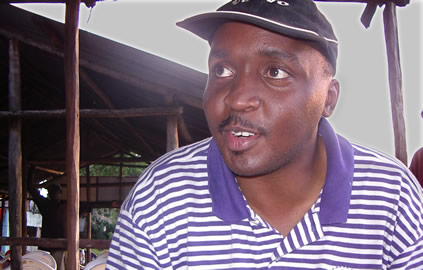 |
| Alex Waweru Kimani, Project Lead of the Bigga Boda Trial Market |
Alex brings over 15 years of experience selling high-capital goods in Kenya. From selling welding gasses to cattle-branding equipment to Volvo trucks to cement, Alex has criss-crossed Kenya countless times. As a truck salesman, Alex saw how valuable bicycles are in delivering the goods and raw materials to homes and businesses. Alex grew up in Nairobi and holds a degree in Electrical Engineering from Kenya Polytechnic.
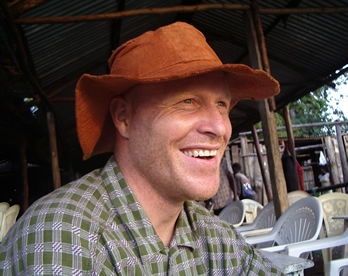
Ed Lucero, Technical Lead, Bigga Boda Trial Market
 |
| Ed Lucero, Technical Lead of the Bigga Boda Trial Market in Kenya, 2005 |
Ed was trained as a welder in the demanding environment of the US Navy, repairing steam pipes and hull leaks during active missions on a frigate. He has headed up the production and design department of a successful jewelry company, and has worked as a custom metal fabricator. As a professional kayaker, designed an armored life vest for kayakers that was aquired by Stohlquist. He also set the world record for taking the highest waterfall in a kayak, a feat he undertook so that he would be able spread a message of peace through the media. An accomplished outdoorsman and traveler, Ed rode his Xtracycle from Idaho to New Mexico, carrying his kayak and stopping to paddle the most promising rivers along his route.
Ed will oversee the production of the fleet of Bigga Boda bicycles from our workshop in Kisumu, Kenya.
Ed grew up in New Mexico and attended the University of New Mexico. |
Members of the Board of Directors:
Adam French, Former Director, Founder: After graduating
from Wesleyan in 1995 with a degree in Philosophy, Adam worked
as a counselor at a wilderness therapy program for troubled
teens, and built wooden boats in Maine and Southern California.
During a trip to visit his father in South Africa in 1999,
he found it more fulfilling building a kitchen in his father's
church than building 5 million dollar boats back home. During
the same trip he started Cool Chess, a program that teaches
middle school children to play chess. Founding XAccess has
allowed him to continue his international work, develop his
mechanical talents, and pursue an interest in transformative
technologies.
Contact: Adam@xaccess.org |
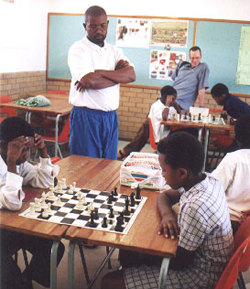 Adam French (leaning, in rear) founded Cool Chess in
South Africa in 1999 and went back to visit in 2002. |
Gay Evans, Adviser: Gay is the Founder and Director of
The Health Education Project for at-risk populations (THE Project)
under the El Rio Health Center in Tucson Arizona. Founded in 1990,
THE Project takes health and life skills classes to vulnerable
persons in Abused Women and Homeless Shelters, Drug and Alcohol
Treatment Programs and Women and Juveniles in Correctional Institutions.
Founded on the premise that prevention is the best way to end
homelessness, it was her hope that taking classes to vulnerable
persons, where they are, would reach them as never before. Armed
with information taught by caring volunteer teachers, these women
might be able to make decisions that would benefit themselves
and their children (and society) now and in the future. In 2002
Gay led 60 volunteers teaching classes to nearly 5000 persons.
Gay graduated as a registered nurse from Oklahoma Baptist University
and earned a Master's Degree in Public Health, Social Sciences
and Education from the University of Minnesota. She received her
Family Nurse Practitioner Certification from the University of
Arizona and worked as a Nurse Practitioner at El Rio Health Center
in Tucson for 27 years.
Ross Evans, Founder, Advisor: Ross founded Xtracycle LLC
in 1997 with his business partner Kipchoge Spencer. Having studied
product design and engineering at Stanford University, and worked
at renowned product-design firm IDEO, Ross leads the product development
at Xtracycle. Ross has taught welding, engine repair, and bike
mechanics in, El Salvador, Mexico, and Cuba. He has helped to
start cargo-bike programs in South Africa, Senegal, and Nicaragua.
Contact: Kipchoge@xtracycle.com
Kipchoge Spencer, Founder, Advisor: Kipchoge has run Xtracycle
LLC since 1999. He is happy to fulfill the social
mission of Xtracycle through his advisory role at XAccess. "We
design bikes that meet the needs of many who can't afford them,"
he says. "Xtracycle Access Foundation is the best way to close
that gap." Kipchoge has also worked at the Rocky Mountain Institute
in Snowmass, where he researched and wrote on sustainable economic
development in former timber communities. Kipchoge has traveled
extensively in Central and South America. He holds a BS degree
in Earth Science from Stanford.
Contact: Ross@xtracycle.com
[ top ]
How can I get involved?
XAccess has great opportunities for you to get involved with our
efforts. Please check out our "Join in" section
for more information. Even if you don't see something that fits
you, call us anyway. We love to get creative and put your ideas
to good use.
[ top ]